

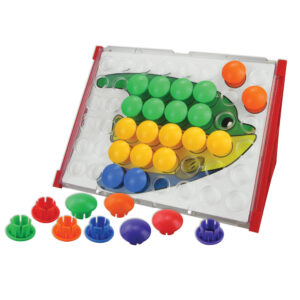
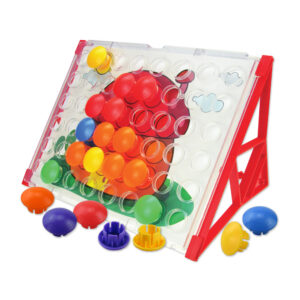
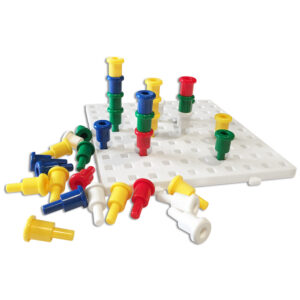
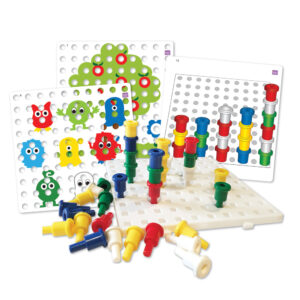
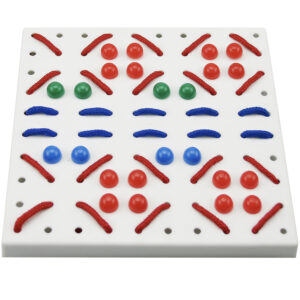
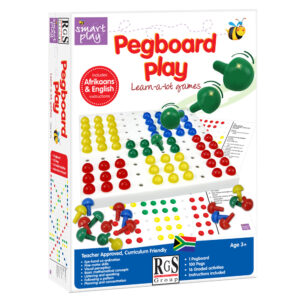
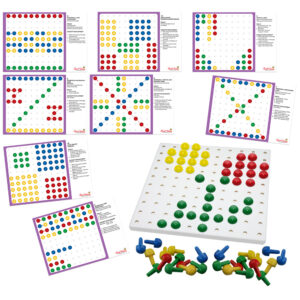
Smartplay Button Designs is an entertaining game which will teach your toddler colours, planning, visual perception and creativity.
Create your own unique patterns or copy the 12 fun pattern cards included. The giant colour button pegs are easy to insert and remove from the board.
The transparent board is can be used on a flat surface or can be easily mounted on a 3-D stand included.
The pegboard is internationally recognised as an important learning tool because while placing the pegs in the pegboard, your child will acquire many school readiness skills including • fine motor control and manual dexterity • hand-eye coordination • visual perception • planning and concentration • creative thinking.
Age 2 .
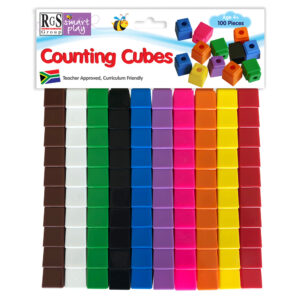
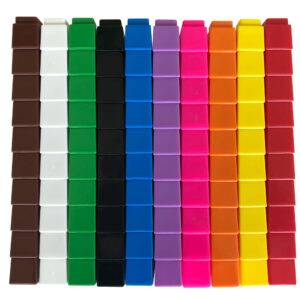
Counting Cubes are supplied in 10 colours to provide learners with hands-on learning experiences which will help them structure their thoughts and learn to think and reason in a more logical manner.
Use Counting Cubes to acquire skills in colour sorting and recognition, counting, grouping, addition, subtraction, multiplication and division to name a few.
The must-have product for early learning! A great special needs product!
Pegboards are internationally recognised as an important teaching aid as they develop and strengthen visual perception skills, visual-motor coordination and fine motor skills including the essential pincer grip.
Our jumbo pegs are ideal for the early learner as they are specially designed for tiny hands to grasp easily and stack up on top of one another too!
While working through the 12 activities your child will also develop basic skills sorting, matching, patterning, planning and concentration.
Afrikaans and English instructions are included.
R419.00Original price was: R419.00.R369.00Current price is: R369.00.
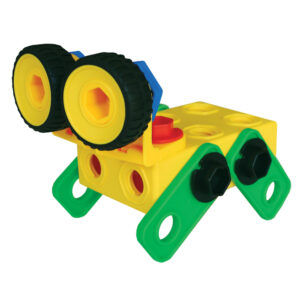
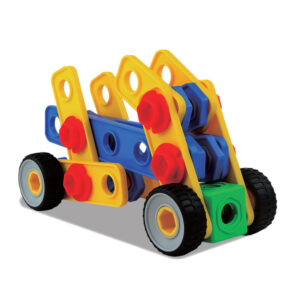
A great product for the young architect or engineer.
Junior Engineer assists in developing many important school readiness skills including fine motor hand and finger muscle development, hand-eye coordination, crossing the midline, colour and shape recognition, sorting and matching and visual perception skills.
This set contains 85 large pieces including working wheels. Largest pieces measure 75 x 120mm.
All pieces are packed in a convenient clear storage container with carrying handle.
Age 3 .
A single 15cm pegboard with small holes is suitable for peg and lacing activities. Use together...
FINE MOTOR SKILLS DEVELOPMENT
Fine motor skills refers to the co-ordination of small muscles in movement with the eyes, hands and fingers. The small muscles in the hands and wrists are used to make precise movements.
Fine motor skills assist children in performing everyday tasks such as feeding themselves, picking up and holding objects, dressing up, holding crayons, pencils, writing , to name a few examples.
Fine motor skills are also necessary for basic self-care activities such as buttoning and unbuttoning clothes, tying shoe laces, brushing teeth, opening and closing lunch boxes and juice bottles.
Activities such as drawing, writing, cutting, building etc also rely on well developed fine motor skills thus impacting a child’s ability in the classroom.
Activities that require fine motor skills often also improve hand-eye co-ordination , which is important for many tasks.
The ability to accomplish these everyday tasks involving good fine motor skills , helps a child’s self esteem and self confidence. This in turn has a positive impact on the child’s emotional development.
There are many activities for the early childhood development stage to promote fine motor skills, for example : building and playing with blocks and construction toys , cutting , threading, lacing, pegboard activities, creating with playdough / clay , finger and brush painting , colouring.
Children should be given every opportunity to practise and develop these activities. Most of these activities are also fun to do, so the child will actually be developing much needed skills without feeling tons of pressure.
The development of fine motor skills is not only limited to young children. Older people also find that their fine motor skills abilities decline with age. This in turn makes it difficult for them to perform simple everyday tasks. Many of the fine motor skills activities that are used for the early childhood development phase can also be incorporated into assisting older people as well.
The development of good strong fine motor skills is an important aspect of development and as such it should not be ignored but rather it should be given the required time and attention that it deserves.