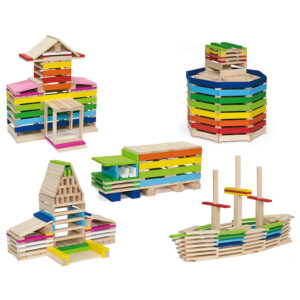
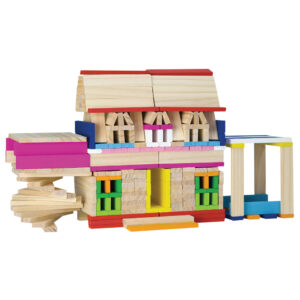
Easy for little fingers to grasp, these brightly coloured classic wood blocks stimulate creativity and hone basic motor skills.
This high-quality block assortment includes natural wood and hand-painted colours. Assorted shapes and sizes enable children to build anything that they can imagine.
These 100-piece sets are packed in a convenient storage barrel with a lid and carry handle. Great for on-the-go play. When not in use, blocks can be neatly stored away! Blocks are approx. 25mm in size.
A leaflet containing design ideas is included in each set.
Age 2
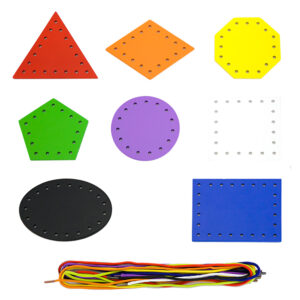
Learn your shapes and colours while mastering your lacing and tracing skills!
This pack contains 8 different wooden shapes in 8 colours plus 8 colour coordinated laces.
Great practise for hand-eye coordination with threading tipped laces. No needles needed.
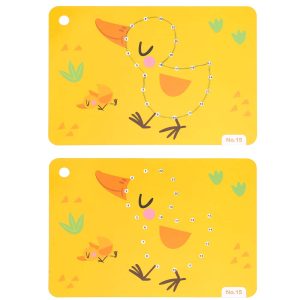
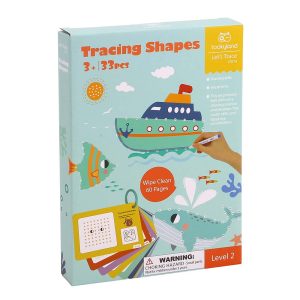
Trace the shapes on paper and create little shape characters.
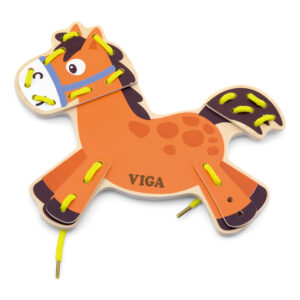
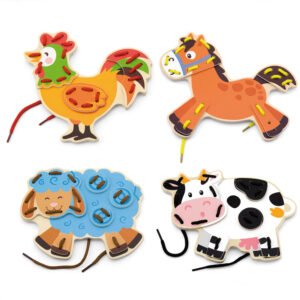
Match the farm animal body parts and lace them together!
Features 4 adorable farm animals: sheep, cow, horse, rooster and 4 laces in different colours.
Match the cute heads, legs, arms and tails with the same pattern underneath, then lace them to get live 3-D animals.
Assists in practising hand-eye, fine motor and memory skills.
Excellent for developing logical thinking, practising hand-eye coordination, fine motor and memory.
Size: 210 x 190 x 45mm.
R249.00Original price was: R249.00.R229.00Current price is: R229.00.
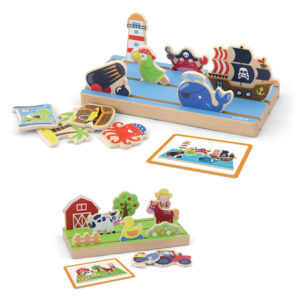
Distance and Space are complex concepts for young children to understand. Is something behind or in front? Is it off to the side and how many layers are there?
The Viga Learning Space and Distance set can help to understand these in a fun and playful way.
The set contains a double-sided wooden board, wooden shapes like animals, trees, ships, houses and a set of cards to replicate scenes.
This fun toy develops hand-eye coordination, shape and colour recognition and logical thinking.
Age 18 months.
It’s dress-up time, boys and girls!
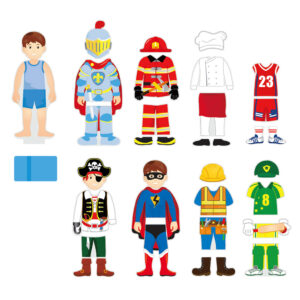
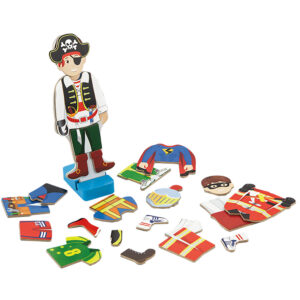
These Magnetic Dress-Up set includes a magnetic wooden doll with a wooden base stand and colourful, attractive magnetic outfits and accessories for pretend play!
The 36 pieces in outfits and accessories make up 8 matching suits.
This toy is a great way to encourage hand-eye coordination, fine motor skills, creativity and vocabulary building.
R189.00Original price was: R189.00.R169.00Current price is: R169.00.
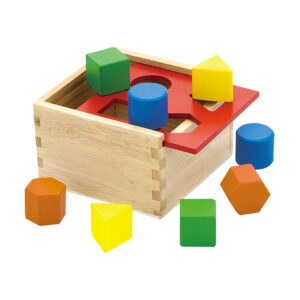
This classic wooden sorting box made of high-quality wood is designed to encourage hand-eye coordination and...
FINE MOTOR SKILLS DEVELOPMENT
Fine motor skills refers to the co-ordination of small muscles in movement with the eyes, hands and fingers. The small muscles in the hands and wrists are used to make precise movements.
Fine motor skills assist children in performing everyday tasks such as feeding themselves, picking up and holding objects, dressing up, holding crayons, pencils, writing , to name a few examples.
Fine motor skills are also necessary for basic self-care activities such as buttoning and unbuttoning clothes, tying shoe laces, brushing teeth, opening and closing lunch boxes and juice bottles.
Activities such as drawing, writing, cutting, building etc also rely on well developed fine motor skills thus impacting a child’s ability in the classroom.
Activities that require fine motor skills often also improve hand-eye co-ordination , which is important for many tasks.
The ability to accomplish these everyday tasks involving good fine motor skills , helps a child’s self esteem and self confidence. This in turn has a positive impact on the child’s emotional development.
There are many activities for the early childhood development stage to promote fine motor skills, for example : building and playing with blocks and construction toys , cutting , threading, lacing, pegboard activities, creating with playdough / clay , finger and brush painting , colouring.
Children should be given every opportunity to practise and develop these activities. Most of these activities are also fun to do, so the child will actually be developing much needed skills without feeling tons of pressure.
The development of fine motor skills is not only limited to young children. Older people also find that their fine motor skills abilities decline with age. This in turn makes it difficult for them to perform simple everyday tasks. Many of the fine motor skills activities that are used for the early childhood development phase can also be incorporated into assisting older people as well.
The development of good strong fine motor skills is an important aspect of development and as such it should not be ignored but rather it should be given the required time and attention that it deserves.